
Inertia Demonstrator Rotational Manufacturer,Supplier and Exporter in India
.jpg)
Product Code : SCL-PLE-11895
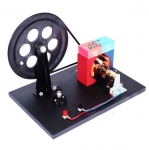
The Inertia Demonstrator Rotational by Scientifc Equipment is an educational physics laboratory apparatus designed to demonstrate rotational inertia, moment of inertia, angular motion, torque, mass distribution, angular acceleration, rotational stability, and Newton’s laws of motion in rotating systems. It is suitable for school physics laboratories, college science labs, STEM classrooms, mechanics lessons, teacher demonstrations, and supervised student practical experiments.
This apparatus helps students understand that rotating objects resist changes in their rotational state just as linear objects resist changes in straight-line motion. It provides a clear and practical way to observe how mass position, radius, and applied torque affect rotational motion.
Product Description
Rotational inertia is the resistance of an object to changes in its rotational motion. The Inertia Demonstrator Rotational allows students to observe how objects with different mass distributions rotate differently when the same force or torque is applied. By adjusting masses, changing radius, or comparing different rotating bodies depending on product configuration, students can study moment of inertia in a hands-on way.
The Scientifc Equipment Inertia Demonstrator Rotational may include a rotating platform, axle, support stand, adjustable masses, disk, ring, rod, pulley, string, weight hanger, base, scale markings, and activity accessories depending on product configuration. It is designed for supervised educational and laboratory demonstration use only.
Key Features
- Educational apparatus for demonstrating rotational inertia and moment of inertia.
- Useful for teaching torque, angular acceleration, mass distribution, and rotational motion.
- Helps students observe how moving mass farther from the axis changes rotation.
- May include adjustable masses, rotating disk, axle, pulley, or stand depending on configuration.
- Supports qualitative and quantitative mechanics demonstrations.
- Suitable for physics labs, STEM activities, rotational dynamics lessons, and classroom teaching.
- Encourages observation, measurement, calculation, comparison, graphing, and scientific reasoning.
- Ideal for teacher-led demonstrations and supervised student practical work.
- Designed for educational laboratory use only.
Product Specifications
|
Product Name |
Inertia Demonstrator Rotational |
|
Brand |
Scientifc Equipment |
|
Product Type |
Educational Rotational Inertia and Moment of Inertia Demonstration Apparatus |
|
Application |
Rotational Inertia Demonstration, Moment of Inertia Study, Torque Experiment, Angular Acceleration Practical, STEM Learning, and Classroom Teaching |
|
Working Principle |
Objects Resist Changes in Rotational Motion, and the Resistance Depends on Mass Distribution Around the Axis of Rotation |
|
Possible Components |
Rotating Platform, Axle, Support Stand, Base, Adjustable Masses, Disk, Ring, Rod, Pulley, String, Weight Hanger, Scale Markings, and Activity Sheet Depending on Product Configuration |
|
Possible Material |
Metal, Aluminium, Steel, Brass, Plastic, Acrylic, Wooden Base, Bearing Assembly, and Educational-Grade Laboratory Materials Depending on Model Design |
|
Demonstration Type |
Rotational Inertia, Moment of Inertia, Angular Acceleration, Torque Response, Mass Distribution Effect, and Rotational Stability Observation |
|
Measurement Type |
Rotation Time, Angular Speed, Applied Load, Torque Effect, Radius Variation, Mass Position, Acceleration, and Moment of Inertia Comparison Depending on Setup |
|
Power Requirement |
No Electrical Power Required Unless Used with Optional Sensors or Timing Accessories |
|
Compatible Accessories |
Stopwatch, Photogate, Motion Sensor, Slotted Weights, Meter Scale, String, Pulley, Activity Sheet, Graph Paper, Calculator, and Physics Practical Notebook |
|
Educational Use |
Physics Lesson, Mechanics Practical, Rotational Dynamics Demonstration, Moment of Inertia Activity, STEM Project, and Student Laboratory Work |
|
Suitable For |
Schools, Colleges, Physics Laboratories, Science Rooms, STEM Labs, Teacher Training Centers, and Educational Institutions |
|
Learning Topics |
Rotational Inertia, Moment of Inertia, Torque, Angular Acceleration, Angular Velocity, Mass Distribution, Radius of Rotation, Rotational Kinetic Energy, and Mechanics |
|
Operation |
Manual Setup, Mass Adjustment, Rotational Release, Time Measurement, Motion Observation, Result Recording, Calculation, and Supervised Classroom Demonstration |
|
Important Note |
For Educational and Laboratory Demonstration Use Only; Size, Mass Set, Axis Design, Bearing Type, Accessories, and Experimental Arrangement Depend on Product Configuration |
How to Use
- Place the Inertia Demonstrator Rotational on a stable, clean, dry, and level laboratory bench.
- Inspect the rotating platform, axle, stand, base, masses, pulley, string, and accessories before use.
- Set up the apparatus according to the teacher’s experiment plan or supplied activity guide.
- Attach the adjustable masses at equal distances from the axis if the model includes movable masses.
- Apply a small controlled torque using the recommended method, such as a string and weight hanger, if included.
- Release the system carefully and observe the rotational motion.
- Measure the time taken, angular speed, or number of rotations depending on the activity.
- Move the masses closer to or farther from the axis and repeat the experiment.
- Compare how the change in mass position affects angular acceleration and rotational response.
- Record observations and calculate moment of inertia or compare results where applicable.
- Allow the rotating system to stop completely before making adjustments.
- After the experiment, remove weights, organize accessories, and store the apparatus safely.
Safety and Handling Instructions
- Use only under teacher, laboratory instructor, or trained adult supervision.
- Ensure the apparatus is stable before rotating or applying torque.
- Keep fingers, hair, loose clothing, jewelry, and small objects away from rotating parts.
- Do not touch the rotating platform, axle, string, pulley, or masses while in motion.
- Do not overload the apparatus with excessive weights beyond the recommended capacity.
- Allow the system to stop fully before adjusting masses or changing the setup.
- Do not spin the apparatus aggressively or use it as a toy.
- Keep the working area clear to prevent weights or accessories from falling.
- Do not use damaged axles, loose masses, bent rods, cracked bases, unstable stands, or worn strings.
- Store all weights and accessories in a clean, dry, and protective place after use.
Educational Applications
- Demonstrating rotational inertia in moving systems.
- Teaching moment of inertia and mass distribution.
- Studying how radius affects resistance to angular acceleration.
- Explaining torque and angular motion.
- Comparing rotational response with different mass positions.
- Introducing rotational kinetic energy and angular velocity.
- Supporting mechanics, rotational dynamics, and STEM practical lessons.
- Encouraging observation, prediction, timing, measurement, calculation, graphing, and scientific reasoning.
Why Choose Scientifc Equipment Inertia Demonstrator Rotational?
The Scientifc Equipment Inertia Demonstrator Rotational provides a practical and visual way to teach rotational inertia and moment of inertia. By allowing students to observe how mass distribution affects rotation, the apparatus makes rotational dynamics easier to understand through supervised hands-on laboratory learning.
FAQ
- What is the Inertia Demonstrator Rotational used for?
It is used to demonstrate rotational inertia, moment of inertia, torque, angular acceleration, mass distribution, and rotational motion.
- Is this apparatus suitable for school physics laboratories?
Yes, it is suitable for school physics labs, college science labs, STEM classrooms, mechanics lessons, and supervised student practical experiments.
- What principle does the apparatus demonstrate?
It demonstrates that rotating objects resist changes in rotational motion, and this resistance depends on the distribution of mass around the axis.
- Does the apparatus require electricity?
No, the basic apparatus is manually operated and does not require electricity unless optional sensors or electronic timing accessories are used.
- Can students change the mass position?
If the model includes adjustable masses, students can change the mass position under teacher supervision to compare the effect on rotational inertia.
- What measurements can students take?
Students can measure rotation time, angular speed, applied load, radius, acceleration, and compare moment of inertia depending on the experiment setup.
- Can students use the apparatus independently?
Students should use it under teacher or laboratory instructor supervision because it involves rotating parts, weights, strings, and measurement activities.
- How should the Inertia Demonstrator Rotational be stored?
Store the rotating platform, masses, axle, stand, pulley, strings, and accessories in a clean, dry, and protective place away from moisture, dust, chemicals, impact, and rough handling.
SEO Keywords
Inertia Demonstrator Rotational, Scientifc Equipment Inertia Demonstrator Rotational, rotational inertia apparatus, moment of inertia demonstrator, school physics rotational inertia model, torque and angular acceleration apparatus, STEM rotational dynamics kit, mass distribution demonstration, mechanics lab inertia apparatus, physics lab rotational motion model, educational moment of inertia apparatus, rotational dynamics teaching aid.
SEO Meta Title
Inertia Demonstrator Rotational – Scientifc Equipment
SEO Meta Description
Buy Inertia Demonstrator Rotational by Scientifc Equipment for school physics labs, rotational inertia demonstrations, moment of inertia experiments, torque and angular acceleration lessons, STEM activities, and supervised classroom learning.
Google E-E-A-T Focused Content
This product content is prepared to support teachers, school buyers, laboratory suppliers, physics educators, STEM coordinators, mechanics instructors, lab technicians, students, and educational institutions with clear product information, practical specifications, usage guidance, safety instructions, and helpful FAQs. The content focuses on accurate educational rotational dynamics applications, supervised rotational inertia demonstrations, safe handling of rotating parts and weights, moment of inertia learning, mass distribution observation, and trustworthy product guidance while clearly stating that the product is for educational and laboratory demonstration use only.
.jpg)
.jpg)
.jpg)
.jpg)
.jpg)
 (1).png)